
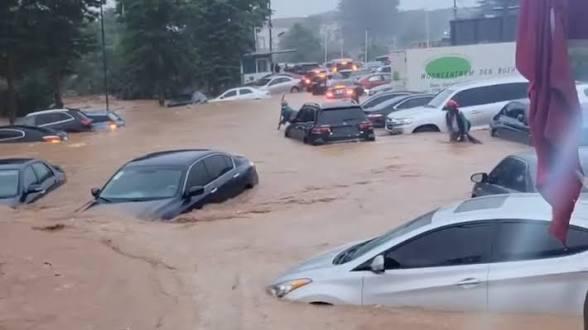
How Abuja's Annual Flooding Affects Families
Ijeoma Kenn Nwoga, a resident of Abuja, still mourns her husband and two children who died after a flood swept away their vehicle as they were trying to cross a makeshift culvert. For almost nine years, Ijeoma has been reeling from that tragic experience; every rainfall brings back painful memories.
By The Context · September 28, 2026
Located within Abuja's cadastral zone, Lokogoma remains one of several communities struggling with poor road infrastructure and inadequate drainage. Despite its proximity to the city center, during the rainy season, overflowing floodwaters regularly submerge roads, damage vehicles, and in some cases claim lives.
For 48-year-old Ijeoma Kenn Nwoga, every rainfall brings back painful memories. In 2017, she lost her husband and two children after floodwater swept away their vehicle while crossing a makeshift culvert within the Lokogoma area of Abuja.
The widow said the government failed to fulfill promises of support made to her after the death of her husband and children. “When my husband died, a representative from the FCT came to the house. He made promises that I shouldn't bother about my children, that they will be well taken care of. Up until now, nothing,” she says.
Ijeoma laments that nine years after the tragic incident, the deadly culvert is yet to be fixed. “They will be measuring the place, you will think something will be done. By the end of the day, nothing will be done. So year in, year out, we contribute money to make sure that the flood doesn't get worse, but when it rains heavily, those palliatives will be washed away.”
Some residents of the affected community also raised safety concerns and the risks posed by the poor culvert and the drainages. More than eight years after the tragedy, residents say the promised culvert has yet to be constructed, leaving the community exposed to the same danger every rainy season.
“It has been a headache to the environment, because this stream comes straight from where the new hospital is now down to EFAB, and we've lost a lot of people here. It's not only me, but every person that is living around this place, he must not be happy because the road is bad all the time. You understand? Anytime it rains, the same water will be flooding, like everywhere will be occupied with water, and it's not good like that, and it's very risky for our lives,” says Patrick Simwal, a resident of the affected community.
The deadly culvert of Lokogoma is located less than 1 kilometer away from the newly commissioned Apo-Kabusa road, approximately 492 meters according to measurements obtained from Google Earth. Yet despite its closeness to a major highway, the access road remains in poor condition, raising concerns over the pace of infrastructure development under the Abuja master plan.
Experts and town planners are also worried about the encroachment of green areas and the failure of authorities to develop road and drainage infrastructure before buildings are erected.
Town Planner Shuaibu Umar, a former Coordinator of the Abuja Metropolitan Management Council, holds similar views. “Definitely the area is not yet planned, and definitely whenever there is rain there tends to be some sort of obstruction on the part of the rain. When you have an area that is a natural ground then you have developments that are coming up naturally, the rainfall will not have access to percolate into the ground. So what will result is runoff,” Shuaibu explains.
For Ijeoma, the appeal is deeply personal. She says no family should have to endure the pain of losing loved ones to a disaster that could have been prevented. “Because my husband's life was wasted. It was a waste. If not for that road, maybe he would have been alive up till today, nobody knows, but the road consumed him, consumed my daughter.”
According to the Federal Ministry of Water Resources, 14,000 communities across 33 states including the FCT are at risk of flooding in the 2026 rainy season, and this part of Lokogoma is included as you can see. But beyond the flood alerts, the question is, what measures were put in place to avert or mitigate the impact of the floods?